
Contents

In brief
- 1.No law names PAT testing, and no law sets a universal fixed interval. The Health and Safety Executive says in plain words that the law doesn’t require every appliance to be tested every year.
- 2.What the law does require is that electrical equipment is maintained so it doesn’t become dangerous (Electricity at Work Regulations 1989). Inspection and testing with records is the recognised way to prove you’ve done that.
- 3.Since December 2025, social landlords in England have an explicit duty to have the electrical equipment they supply safety-checked.
- 4.Even where the law is silent, insurers and venues demand current test records. In practice, PAT is how organisations stay defensible.
The straight answer
Search this question and you’ll find confident answers in both directions. Both are half right. PAT testing, the routine of inspecting and testing plug-in appliances and labelling them, is a method. No statute mandates the method. Several statutes mandate the outcome: equipment that doesn’t put people in danger. PAT testing exists because it’s the recognised, insurable, court-tested way of demonstrating that outcome.
The law doesn’t require PAT testing. It requires safe equipment, and expects you to prove it. That distinction decides who gets prosecuted after a fire.
What each law actually requires
| The law | Who it binds | What it actually says |
|---|---|---|
| Health and Safety at Work Act 1974 | Employers and the self-employed | The general duty to ensure, so far as reasonably practicable, the safety of employees and anyone else affected by the business. |
| Electricity at Work Regulations 1989 | Employers, employees, duty holders | The core duty: electrical systems must be maintained, so far as reasonably practicable, to prevent danger. This is the regulation PAT testing exists to satisfy. It never mentions PAT, and it names no interval. |
| Electrical Equipment (Safety) Regulations 2016 | Anyone supplying electrical equipment | Equipment supplied has to be safe. Written mainly for manufacturers and sellers, but it's also why the fridge or kettle a landlord provides with a let must not be dangerous. |
| The 2025 social-rented extension regulations | Social landlords in England | The new one. Landlord-supplied electrical equipment must be safety-checked at regular intervals: new tenancies from 1 December 2025, existing tenancies from 1 May 2026, all checks done by November 2026. |
| HMO licensing conditions | Landlords of licensed HMOs | Set locally, and appliance-testing conditions are commonly attached to the licence, frequently on an annual cycle. |
Notice what’s missing from every row: the words “portable appliance testing”. The duties are real and enforceable. The method is left to you, judged afterwards by whether what you did was reasonable. (The 2025 instrument’s full name, for the record, is the Electrical Safety Standards in the Private Rented Sector (England) (Amendment) (Extension to the Social Rented Sector) Regulations 2025.)
Where the “every year by law” myth came from
The annual-PAT myth is commercially convenient, and the HSE has spent years politely debunking it. Its guidance says outright that the law doesn’t require inspection or testing of appliances annually, or at all as a fixed routine. What the recognised guidance, the IET Code of Practice for In-Service Inspection and Testing of Electrical Equipment, actually describes is a risk-based system: user checks before use, formal visual inspections, and combined inspection and testing with an instrument. How often each happens depends on what the equipment is, how it’s used, and where it lives.
So a kettle in a busy site cabin and an identical kettle in a quiet office can sit on legitimately different schedules. A blanket “everything, every year” policy over-tests the office and, more dangerously, can under-test the site.
Who this lands on in practice
Employers and duty holders
Any workplace with electrical equipment carries the 1989 Regulations duty. In practice that means an equipment register, a risk-based schedule and records. Which is exactly what a PAT regime produces.
Private landlords
Any appliance you supply with a let must be safe, and test records are the accepted evidence. Furnished lets and HMOs sit at the sharp end of this, and HMO licences often make testing an explicit condition.
Social landlords
The 2025 Regulations turned good practice into an explicit legal duty in England. Housing associations and councils are building that checking capacity right now, which is quietly increasing demand for qualified testers.
Event traders and exhibitors
Venues almost universally require a current PAT test certificate before a stallholder or performer plugs anything in. That’s contract rather than law. The effect is the same, because no certificate means no pitch.
What happens if you ignore it
Nobody gets fined simply for “not doing PAT”. The consequences arrive through the side door, and they’re worse.
After an incident, the duty is judged in hindsight. If faulty equipment injures someone or starts a fire, investigators ask what maintenance system existed. A register and test records are a defence. Nothing is an admission.
Insurance.Policies routinely expect legal compliance and reasonable maintenance. A fire traced to an unmaintained appliance with no records is exactly the conversation you don’t want to have with a loss adjuster.
Lost work. For traders, no certificate means no venue. For contractors, client sites demand evidence before equipment comes through the gate.
Who is allowed to do the testing
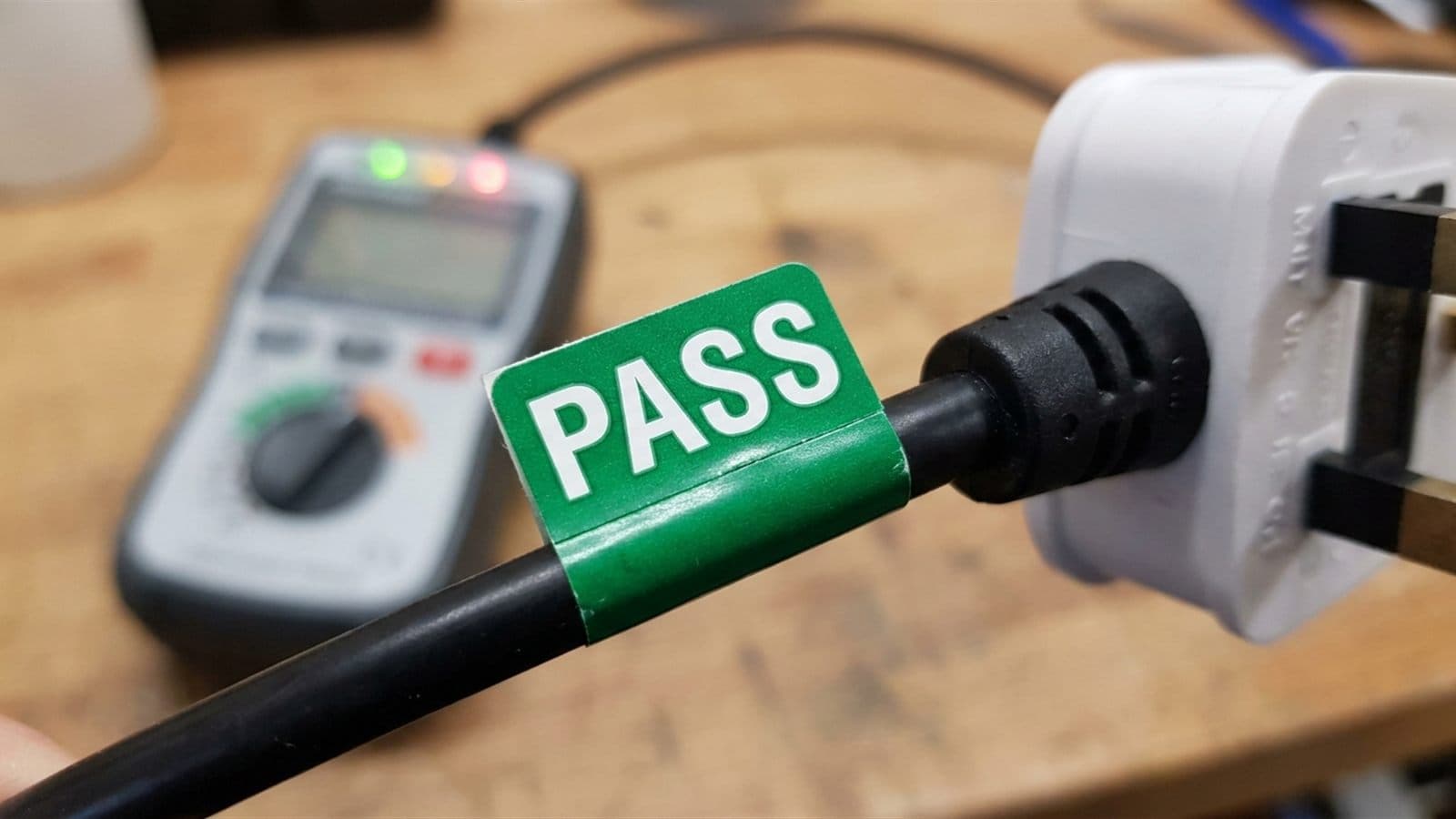
Here’s the part that surprises people. The law asks for competence, not a licence, and you don’t need to be a qualified electrician. The recognised route to demonstrating competence is the City & Guilds Level 3 Award in the In-Service Inspection and Testing of Electrical Equipment (2377-77), the current “PAT qualification”. It has no formal entry requirements.
That’s why the people taking it are as often facilities managers, caretakers and career changers as they are electricians. An organisation can bring its testing in-house with one trained person. And a self-employed tester can build a round out of the demand described above: 2025-26 trade cost guides report per-item rates of £1 to £3, minimum call-outs of roughly £40 to £80, and day earnings commonly in the £150 to £300 range. Equipment guides suggest the whole start-up, the 2377-77 course plus an entry-level tester, commonly comes in under about £1,200, with basic testers retailing from roughly £300.
Already an electrician? The bigger money sits one qualification up, in periodic inspection: our guide to how hard the 2391 really is covers what that exam takes.
Your questions, answered
What does a PAT test actually mean?
PAT stands for portable appliance testing: checking that plug-in electrical equipment is safe to use. A full PAT combines a visual inspection (plug, cable, casing) with instrument tests such as earth continuity and insulation resistance. The formal name nowadays is in-service inspection and testing of electrical equipment, which is why the current qualification is worded that way.
Do I legally need a PAT test certificate?
No law demands a certificate as such. What you need is evidence that equipment is maintained safely, and the certificate plus the test record is how everyone evidences it. In practice venues, clients and insurers ask for a current PAT test certificate before you plug anything in, so the paperwork matters even though no statute names it.
How often does PAT testing legally have to be done?
No law sets a fixed interval. The legal duty is to keep equipment safe, and the recognised approach, set out in the IET Code of Practice, is to set frequencies by risk: how the equipment is built, how it's used, and where. A drill on a building site needs checking far more often than a monitor in an office.
Do brand-new appliances need a PAT test?
No. New equipment should be supplied safe, so a visual check for damage in transit is the usual step, with the item added to the equipment register so it enters the normal testing cycle from then on.
Can I do PAT testing myself, or does it need an electrician?
The law asks for competence rather than a specific licence, and you don't need to be a qualified electrician. Competence is usually evidenced with a recognised qualification such as the City & Guilds 2377-77, which has no formal entry requirements.
Is PAT testing a legal requirement for landlords?
Private landlords must ensure any electrical appliances they supply are safe, and keeping test records is the accepted way to evidence that. Since the 2025 regulations, social landlords in England must have landlord-supplied electrical equipment safety-checked, applying to new tenancies from 1 December 2025 and all existing social tenancies from May 2026. Local HMO licences also commonly attach appliance-testing conditions.
Ready to get qualified?
PAT Testing: In-Service Inspection & Testing: theory online at your own pace, assessment at our Derby centre.
Keep reading